
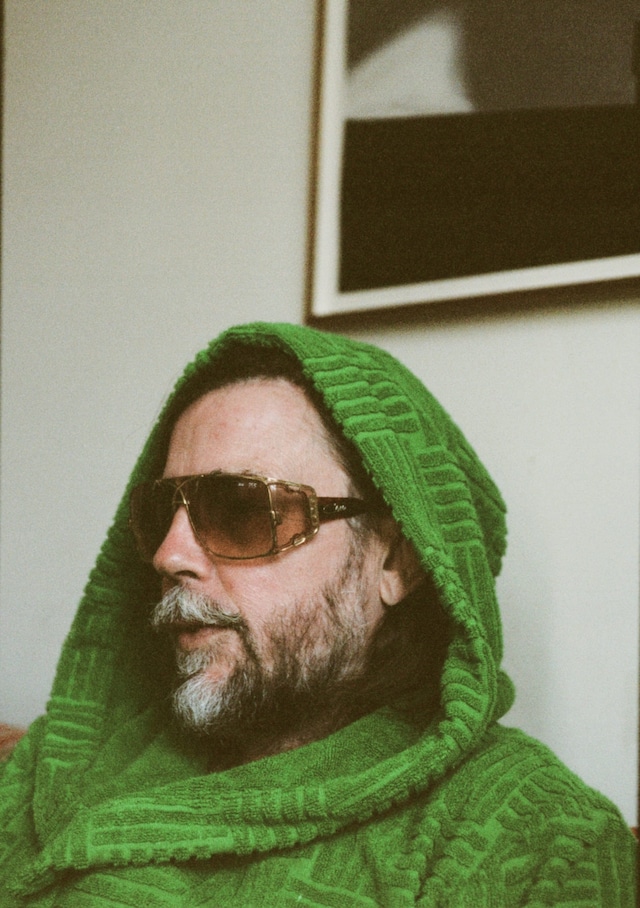
British artist Mark Leckey curated the soundtrack for Louise Trotter’s latest Bottega Veneta show, drawing on his iconic video work Fiorucci Made Me Hardcore
Mark Leckey is keeping his cards, or rather his tracklist, close to his chest. For Spring/Summer 2027, the British artist and occasional DJ was enlisted by Louise Trotter to soundtrack Bottega Veneta’s white-walled catwalk in Milan. It’s his third collaboration with the fashion house, as far as he can remember, and “by far the biggest” to date, with Trotter – a fellow alum of Newcastle Polytechnic in the Nineties – finding a resonance, or perhaps a dancehall echo, in his acclaimed 1999 sound and video work Fiorucci Made Me Hardcore.
“Louise and I are both from the north of England, which I think gives you a certain outlook,” Leckey tells AnOther. “And we both have a similar experience [of] the dance music scene in the UK.”
In case you’re unfamiliar, Fiorucci Made Me Hardcore (or just Fiorucci) is a 15-minute work taking the viewer on a hauntological tour of British dance subcultures, from Seventies disco through Northern soul to the Nineties rave scene. The title, Leckey has said in the past, is about how “something as trite and throwaway and exploitative as a jeans manufacturer can be taken by a group of people and made into something totemic, and powerful, and life-affirming”.
 Video)

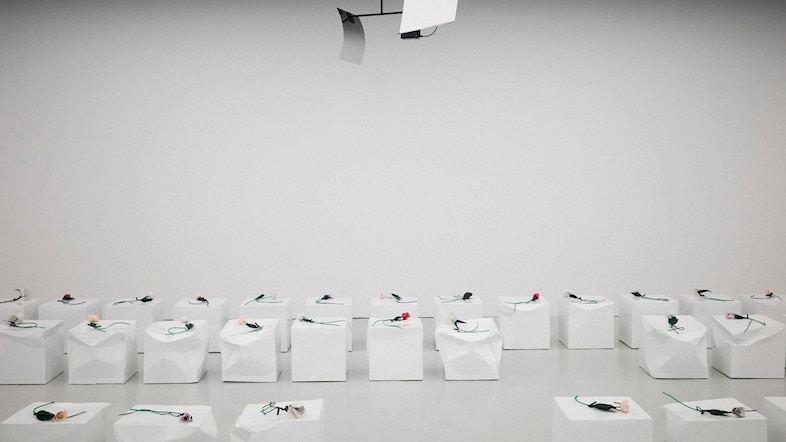
The “throwaway” part hardly applies to Trotter’s Bottega, where silk taffeta shirts, hand-woven leather and raw raffia bags demonstrated careful craftwork and an abundance of attention. But something “totemic, and powerful, and life-affirming”? That could apply not just to the clothes, but to the set itself, with a mirrored soundscape by the artist Florian Hecker and cardboard box seats crushed in a hug by Illya Goldman Gubin.
But back to the music. In the tracklist, there were clear hints at the kinds of sounds that run throughout Fiorucci and haunt, in many ways, the rest of British culture. A pitched-up Shirley Bassey vocal. A tick-tocking dance beat synced to the model’s heels. On social media, Tyler, the Creator could be seen vibing out in the front row to a chopped and screwed jungle track from the early Nineties.
“We discussed the idea of evolving through the decades of the second half of the 20th century, from the Sixties to the Nineties,” Leckey says of the soundtrack. As part of the process, he adds: “I was happy to revisit Fiorucci.” This is years after a hard drive mishap caused him to lose much of the material from the film (ironic, given that the work is a patchwork of found video footage) and was only subsequently reconstructed with the help of fans via YouTube, around 2011.

Fiorucci Made Me Hardcore is an interesting reference point for Trotter in this moment, and it’s hard to resist reading too much into Leckey’s desire to revisit it as well. 2026 is a time when, depending who you ask, subcultures – whether that’s in fashion, personal style, or music – are either accelerating towards the centre of an ever-tightening spiral, or have totally ground to a halt. Stuck. For Leckey, things are just different. “I think subculture in the late 20th century had its own set of conditions and its own objectives that I’m not sure made it far past Y2K,” he says. “The world is very different now and subculture, necessarily, operates in an entirely other way.”
For Trotter’s Bottega, it was the optimism and energy of the musical subcultures in Fiorucci that resonated: the bright futures that genres like disco and rave used to offer up as a possibility. On a more personal note, Leckey adds: “Music introduced me to ways of knowing the world when I was 13 years old and it has been my guide ever since.”
Time and again, we see Leckey bring this passion for music into conversation with his art practice, from music videos, to collaborations with the likes of choreographer Oona Doherty and a regular NTS show. Even within his artworks themselves, music grants access to a kind of emotional affect that lies beyond images – or clothes – on their own. Leckey concludes with a quote from the Victorian art critic Walter Pater, which he admits he always “wheels out” in such circumstances: “All art constantly aspires to the condition of music.” And maybe the same can be said of fashion as well.