
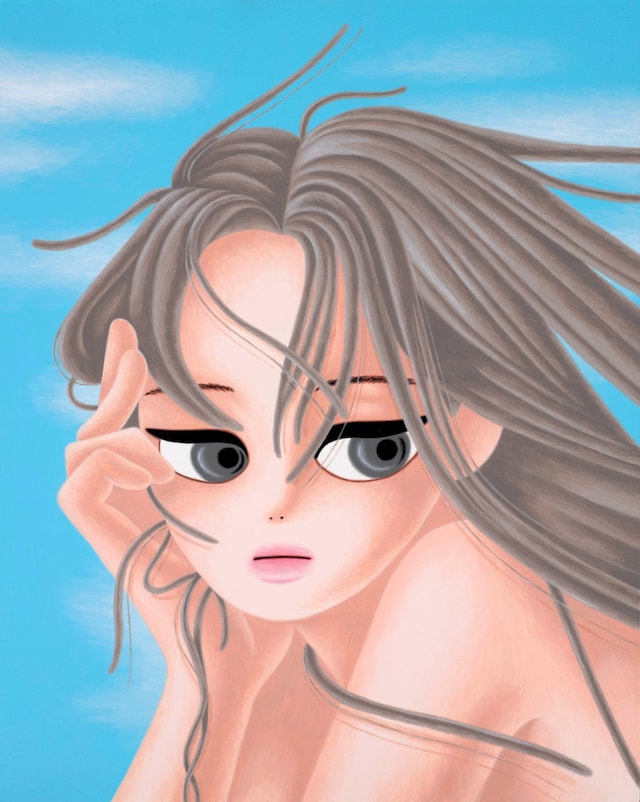
The Korean painter reflects on her dreamy anime-style pop art portraits exploring girlhood, nature and female friendship
Sujin Lee’s visions of girlhood come to her mind fully formed. The Korean artist, whose exhibition Where We Once Stood is currently on show at Saatchi Yates, works with acrylic paints to transpose these visions onto canvas. This body of work presents a series of portraits of young intense-eyed women, most of whom are gazing out at us from a setting in nature, exposed to the elements in some way, be it the wind blowing in from the sea, the lashing rain or snow, surrounded by plant life, or lit by the glow of a sunset.
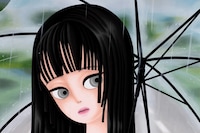
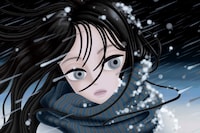
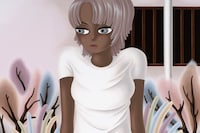

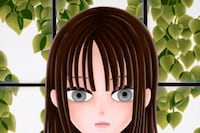
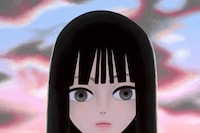
Each young woman in Lee’s work is distinct. She emphasises that the condition or quality of girlhood feels amorphous and hard to grasp in any neat, overarching way. “For me, the girl is difficult to define through any single, clear meaning. I think it is precisely this undefined quality that continues to draw me to her,” she tells AnOther. “When I look at girls, I feel many different, sometimes opposing emotions at once. They seem fragile and somehow sad, yet at the same time beautiful. I feel the desire to protect them, but sometimes also to simply leave them as they are. I place them within a situation and observe how they remain there without intervening.” If anything, for Lee, the figures in her paintings embody a multiplicity of ideas or feelings. “In my work, the girl is less a figure used to express these emotions and more the emotion itself, before it has been clearly named. Sadness, beauty, fragility – these different feelings remain together in a state where they have not yet separated from one another.”
Lee’s aesthetic bears the strong influence of both anime and pop art. Her figures are characterised by exaggeratedly large, expressive eyes and gradient shading with a superflat graphic style. There’s an otherworldly, dreamy quality to the portraits. It’s hard to discern if they are set in the past or the distant future; whether they are earthbound or whether her visions are downloads from another planet entirely.

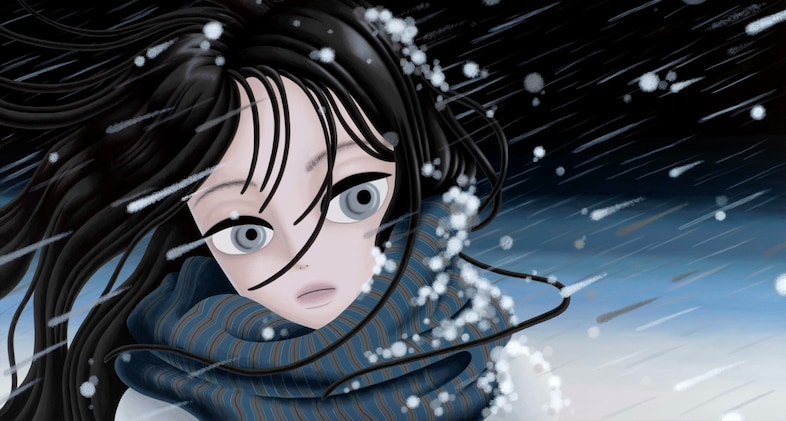
The natural world encroaches Lee’s work in a number of ways. She grew up on Jeju Island where she was “surrounded by an abundance of nature”. Now, living in Seoul, she has to seek it out. “Something that once felt so ordinary that I barely noticed it has now become something I have to go looking for. So nature feels both deeply familiar and somehow distant to me,” she says. In some of her paintings, nature feels wild – whipping a girl’s hair into her face, churning the waves at sea, pelting sleet, or casting eerie blue moonlight shadows. “I am drawn to the indifference of nature,” she explains. “Nature does not intend to protect or harm anyone; it simply exists and changes independently of human will. In the same way that I place a figure within a situation and observe without intervening, nature surrounds the figure without judging or explaining.” Like Mother Nature, Lee exercises the godlike power of the artist over her creations.
Alongside her friendships with women, atmospheric music and cinema, Lee looks to books for inspiration. “Reading is very helpful to my work because of the way books can describe different scenes and emotions in such detail. I also enjoy the process of imagining scenes I have never actually seen, and I think that helps expand my own imagination,” she says. She’s drawn to writing that feels “particularly honest and unfiltered”. She admires the writer’s ability to convey their thoughts in words. “There is something incredibly freeing to me about being able to express emotions or thoughts in such clear and precise language. I think I am still a little shy about expressing myself that directly.” Like many artists, she prefers to allow her images to convey their own meaning, articulating ambiguous feelings visually, rather than linguistically, which might be too crude or literal. “I don’t want to define the atmosphere of my paintings in my own words,” she tells me. “Whatever atmosphere you feel when you look at my painting – that is the atmosphere of the painting.”
Sujin Lee is on at Saatchi Yates until 12 November 2026