
This year’s big-ticket draw at Cannes was a sci-fi monster movie competing for the Palme D’Or – here, its director discusses its long, wild ride to the screen
They don’t show many epic monster movies at the Cannes Film Festival. Even though Na Hong-jin’s previous films (serial killer thriller The Chaser and supernatural horror The Wailing) had established the Korean director at the festival, the action extravaganza of Hope – replete with dense sci-fi lore, scatalogical humour and Oscar-nominated actors playing CGI aliens – was a jolt of adrenaline in this year’s Cannes competition. Somewhere on the Croisette, a jury including Park Chan-wook, Isaach de Bankolé and Demi Moore deliberated whether Hope should win the Palme d’Or.
Now that Hope has been unleashed on audiences, its giddy, unpredictable spectacle demands the biggest screen you can find. In a small Korean village near the DMZ zone, a modest police force come face to face with a ferocious threat: an inhuman creature mutilating livestock and decimating dwellings at a pace that the incompetent police chief Ko Bum-seok (Hwang Jung-min) struggles to keep up with.
“The story begins in the littlest, most lowly place in the world,” says Na, speaking to AnOther via an interpreter over Zoom. “But something happens in that little place that massively impacts the universe. That was the ideal setting for the story I wanted to express.”
Hope is a story of chaotic, cosmic first contact, but closer to the scale of Michael Bay’s Transformers than Steven Spielberg’s ET. Like the nightmarish 2005 remake of War of the Worlds, the first destructive encounter between humankind and the extraterrestrial unknown is immersively and experientially realised; Hope’s entire first act is one elaborate, electric chase sequence through the humdrum village. Na trains his camera on panicked, battle-ready villagers and keeps the monstrous carnage at arm’s length, obscured behind copious rubble and debris. It’s bristling with suspense, humour and visual dynamism, but it’s most unique in structure and pacing – Na kicks off the peril the moment the film begins and keeps the action going long after most American blockbusters would kill the engine, only revealing the uncanny, crudely rendered beast late in the game. The result is some of the most pulse-pounding action of the year.

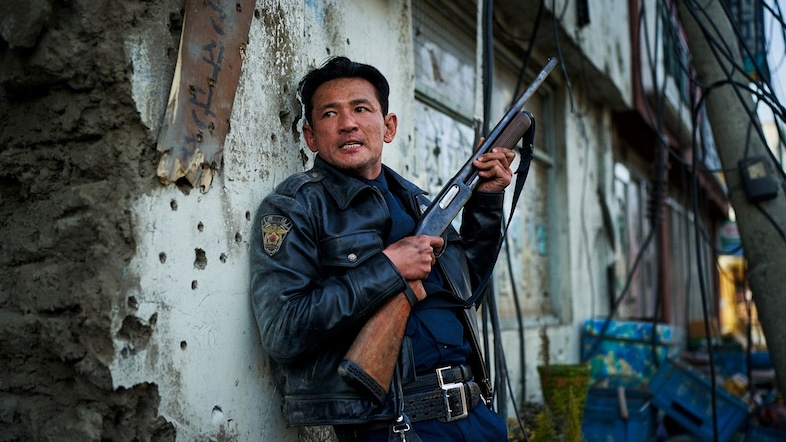
“The first 40 minutes or so is, in a way, a typical introduction of this type of genre film. These days, that particular part gets expressed in very short [bursts] – if you write it as a text, you can summarise it in one line. But I really wanted to expand this particular part. What I wanted to explore was something from another world coming to humankind, and the human point of view reacting and responding to meeting it. I wanted to express the mystery that humans experience. I wanted to put this in the beginning of the film, so expanding it made sense.”
The extended chase also gives us glimpses at Hope’s setting and milieu of characters. Hope Harbor is modest, but clearly no stranger to paranoia: we spot faded propaganda posters, meet armed elderly residents pursuing the new invader, and follow rugged hunters eager to poach the monster themselves. “In this film, we tried to depict humans as very simple,” says Na. “They are lowly characters, flat and simplistic. Showing those characters against a massive landscape, I wanted to bring that point to the audience – to show how little humans can be.”
An action movie populated by impulsive, obstinate and tremulous people – each of whom respond to danger in divergent but recognisably human ways – was the only type of blockbuster Na wanted to make. “I wanted to stress the humanity. In this film, humans are not complex and multi-dimensional. There’s a lot of flaws and negativity. There’s no particular human who’s detailed and identifiable, but rather we look at the humans as a group of living beings.”
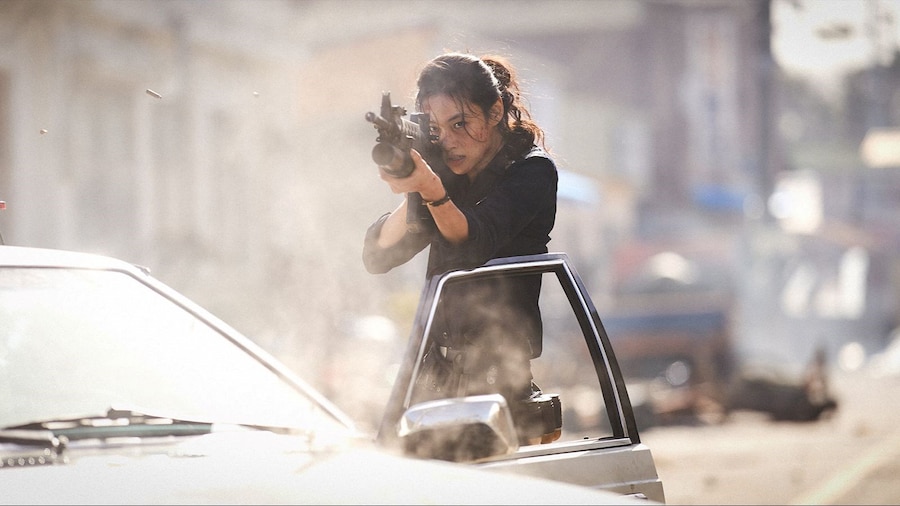
Na’s description of a not-very-heroic ensemble on the edge of desperation and ignorance doesn’t mean there are no memorable standouts in Hope’s cast. Rookie deputy Im Sung-ae (AnOther cover star Hoyeon) makes a lively entrance with a grenade launcher that rivals Sarah Connor’s best heroic moments; local hunter Ko Sung-ki (Zo In-sung) cuts a striking figure wielding a rifle on horseback; and weirdo carpenter Yang-bae (Eum Moon-suk) does a sick bit of trophy-hunting that inadvertently puts the whole planet in jeopardy.

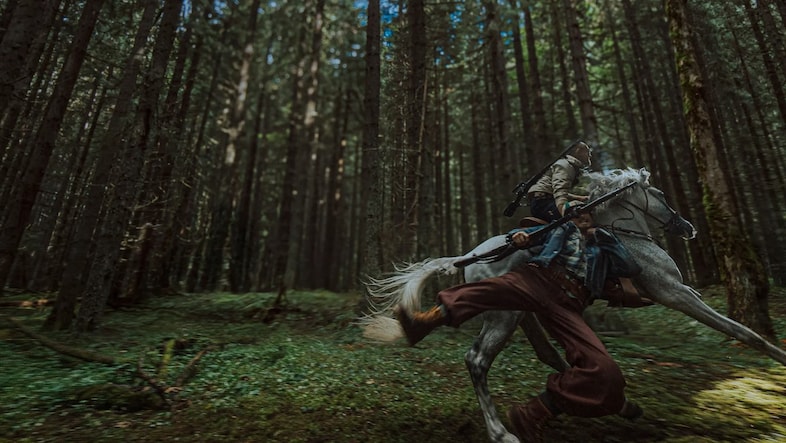
The film’s action turns from Hope Harbor to an alien autopsy, then to carnage in thick forests and a climactic highway chase to rival One Battle After Another. At times, Hope feels like a fusion of sci-fi and western genres. Consider the sheriff confronting a dangerous stranger who rolls into town, the rural posse stalking the wilderness, and the rugged gunman riding a horse into battle. Na was influenced by the sweeping and gritty frontier tone, especially in the finale: a three-pronged duel between a police car, Sung-ki’s stallion, and a sprinting extra-terrestrial. “I thought rather than using machinery and technologies, it would be an interesting contrast to utilise living beings. The humans are being chased by aliens, and in between there’s a horse running very fast. It’s a beautiful living creature that you can actually see; it was an added attraction to the scenery.”
As Hope builds steam, the film gives us longer, deeper looks at the otherwordly invaders who are irked by the village’s combined firepower – tall, gangly creatures reminiscent of 2007-era video game antagonists, now with the visages of Hollywood actors like Michael Fassbender, Alicia Vikander and Taylor Russell. It’s one of the bizarre choices Na made in trying to illustrate the sheer scale of his characters’ ignorance.
“At first, the humans felt above this beast; it turns out to be a noble higher power, while the humans are isolated in the lowest part of the world. As the story goes along, I wanted the gaps between these two groups to get bigger and bigger,” he explains. “In order for the aliens to be understood as having sophisticated feelings, we had to rely on something the audience can understand, and that’s why I relied on humanised facial expressions, using facial expression technology to capture their detailed, delicate feelings.”

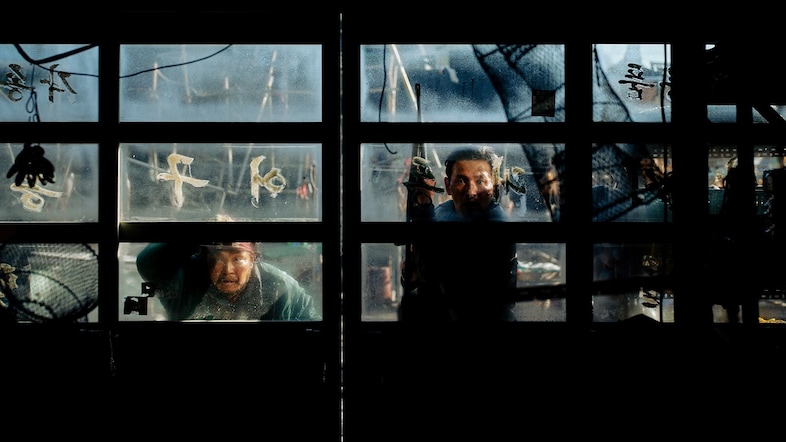
Even in Hope’s final moments, which push the film’s growing sense of human insignificance to overwhelming, Lovecraftian extremes, Na pulls our attention back to his monosyllabic title. “I really think hope is the biggest energy and motivation of life,” says Na. “If you want to live on, you need to have hope. However, if your hope is achieved, the word disappears, it no longer exists. The purpose of turning hope into reality – that’s how you live.”
The drive to change your circumstances and protect others – and the paralysing fear that you can’t – reveals itself as the film’s baseline driving force. “Hope is not a purpose or objective, you need to understand it as a process and an understanding of others. That is what we need. That’s the reason it’s the perfect title,” says Na.
The waves Hope made earlier in the year prompted Na to reveal an already-written, but not officially greenlit, sequel. “There is a little bit more story after what you’ve seen,” he says as he deflects a question about his aliens’ mysterious physiology. How much is a little bit? “Maybe twice as long,” he offers enigmatically. Roll on, Hopes.
Hope is out now in UK cinemas. Read our cover story with Hope star Hoyeon here