
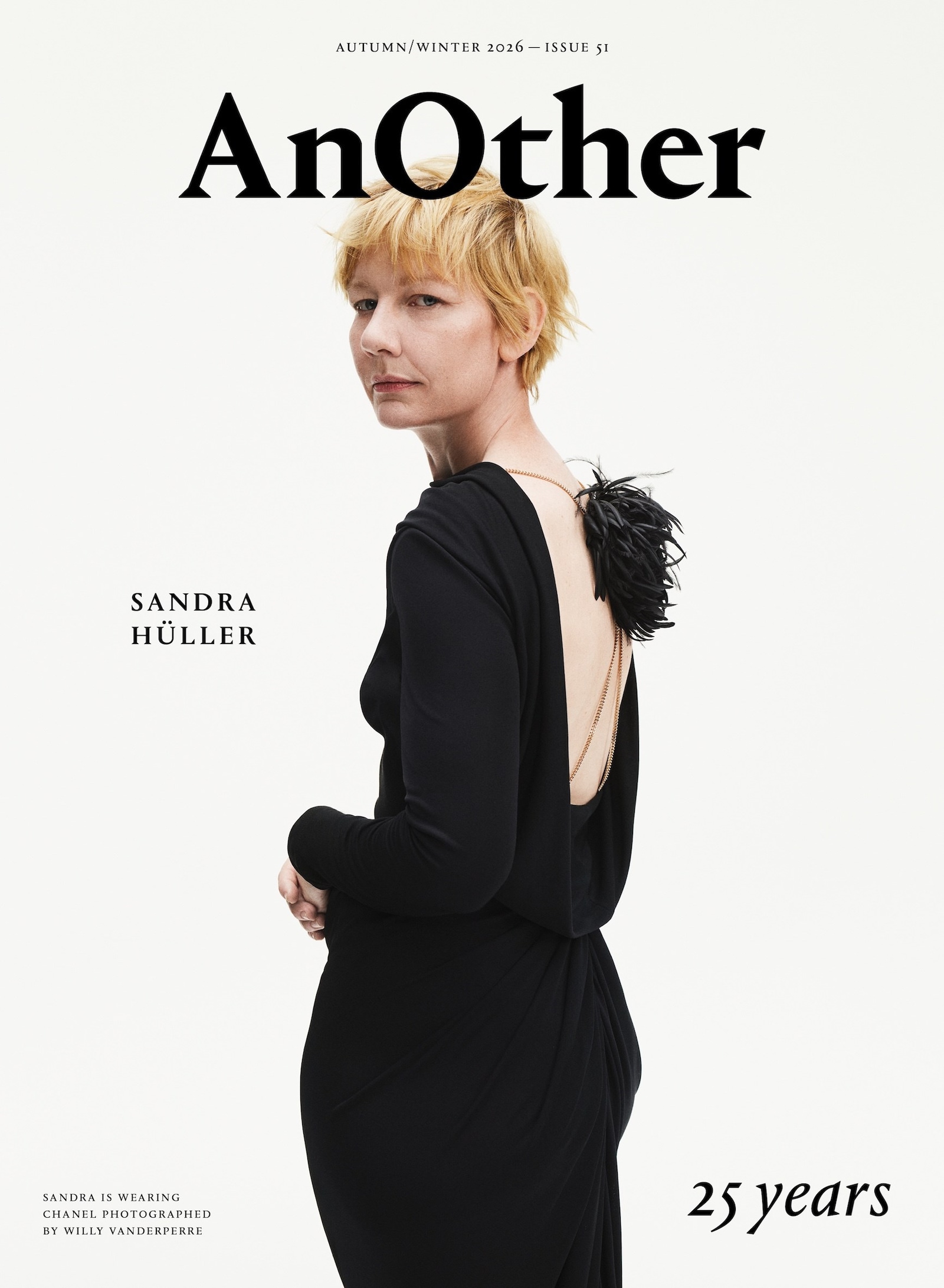
This story is taken from the Autumn/Winter 2026 issue of AnOther Magazine:
The star-crossed Verona teen Juliet Capulet has been reinvented since 1595: as a techno club kid, a gap-year student, the unhappy scion of a criminal syndicate – even an extraterrestrial.
More than four centuries into the Shakespearean heroine’s existence, it takes an audacious energy to reach into her lovesick soul and emerge with an original reading. But when Sandra Hüller walked onto Theatre Basel’s main stage in 2002, barefoot with her hair razor-cut – almost bald, she remembers – she unravelled Juliet, slicing away the clichés of sweetness and playing her tough and unvarnished. The revelation, Hüller realised, was that Romeo would have to love her no matter what; she was free to do as she pleased. That unapologetic turn was responsible for her receiving a young actress of the year award and the agent who still works with her today. The 24-year-old was not yet the bisexual novelist who may or may not have pushed her husband out of a chalet window in Justine Triet’s Anatomy of a Fall, or the cool-eyed technocrat responsible for saving humanity from an alien microbe in Project Hail Mary, or even the tightly wound executive who encourages a colleague to do something unrepeatable with a plate of petits fours in Maren Ade’s unhinged Toni Erdmann. But Hüller’s unfussy Juliet held the kernel of fearless impulses that, 24 years on, has her fêted as a once-in-a-generation actor of radical truthfulness. Hüller’s disinclination to please, her ice-pick intellect and its flipside, a way of bypassing the cerebral cortex altogether and unleashing her intuition, breathes oxygen into her roles. She inhabits them to their fingernails – with her entire physical presence – and, like Marlene Dietrich or Gena Rowlands before her, brings a streak of dark daring to every set. “If I’m standing on the ten-metre diving board, I’ll jump,” she once said. “I don’t get back down, I want to know what it’s like.”



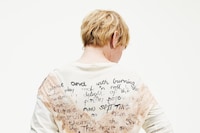


“I think I was a quiet, quiet girl who liked to watch grown-ups and environments,” she says now of her childhood self – picture her with a neat bowl cut and tiny corduroy waistcoat, as seen in the family snaps in the opening credits of Anatomy of a Fall. “I wanted to know how things worked, about the world underneath the world, the things between people that no one talks about. I’m still the same now.” Hüller – black sweater, blonde hair swept back, grey-blue eyes behind glasses – is calling from the home she shares with her teenage daughter and two dogs in Leipzig, the former GDR metropolis in the lowlands of Saxony that is the base she returns to from increasingly international film sets. The first of those dogs, a weimaraner, acted opposite her in Jonathan Glazer’s bone-chilling study of guilt and complicity The Zone of Interest; the second is a newer arrival, a stray she adopted in Poland during the filming of Paweł Pawlikowski’s lean, luminous Fatherland.
With her timeless features, Hüller has ranged freely across eras, from hardscrabble 17th-century rural Germany (Markus Schleinzer’s Rose) to the gilded inner circle of the Habsburg court (Frauke Finsterwalder’s Sisi & I) to the near-future (as a malfunctioning robot in Maria Schrader’s I’m Your Man). For the formidable Erika in Fatherland, she alights in 1949 as the daughter of the literary colossus Thomas Mann, the Nobel-prize-winning author of The Magic Mountain and patriarch of a dynasty that sometimes matched the Kennedys in scandal and tragedy. Shot in inky monochrome, the taut drama’s 82 minutes unfold over a handful of days as father and daughter quit their California exile to take a rain-sodden road trip through the ruins of a newly divided Germany – glittering cocktail receptions peppered with Nazi collaborators in the west, rousing communist anthems and ersatz coffee in the east. Erika was a writer, war reporter and Weimar actor (in political cabaret at the Munich Kammerspiel, incidentally where Hüller herself had a residency eight decades later). In Fatherland she is also her father’s chaperone, picking out his ties and editing the relative clauses from his lofty speeches on Goethe. Reckoning with a society’s sickened soul and the personal wreckage of an unconscionable family grief, the drama jostles with the ghosts of the past, with themes of guilt, trauma and belonging. Hüller returned from the shoot saying she’d learnt more inside Pawlikowski’s meticulously crafted frames than on any other film. “It was a completely new experience,” she says. “I had to find freedom and intensity in just that space and not look as though I was trapped in it. It enabled me to find the essence of something.”
Erika Mann was a firecracker: after fleeing Nazi Germany for Switzerland, she returned disguised to rescue a manuscript of her father’s, recrossing the border with it hidden under the seat of her Ford Model A – a gift from Henry Ford himself after she won a 6,000-mile rally around Europe. When a Nazi plot was concocted to kidnap her, WH Auden proposed marriage and spirited her to the US (a marriage of convenience; Mann was as gay as Auden). Only hints of that backstory surface in Fatherland, but Hüller’s dauntless portrayal leaves no doubt about her character’s strength – her father may be the literary celebrity, but the film’s allegiances are firmly with his gimlet-eyed, bohemian daughter. “I’ve never had the chance to play someone this elegant and cool before,” Hüller says. “She’s so at home in the world. I felt that Erika was a person who took choices deliberately, not because she felt obliged to do anything.”

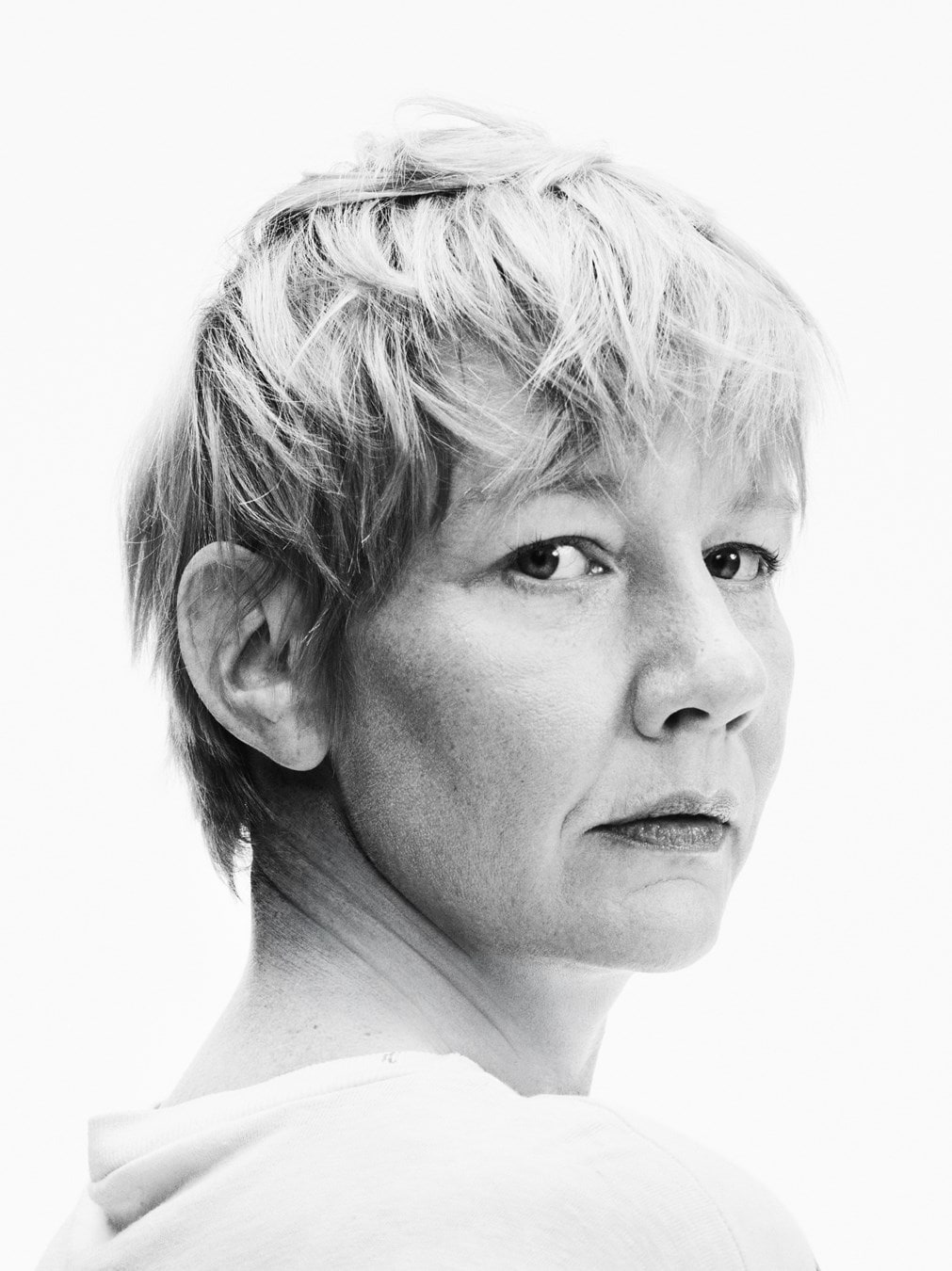
In that, Erika and Hüller are aligned. This year, Fatherland picked up the best director award at Cannes, where a Hüller-esque moment occurred: during a cacophonous photocall on the Croisette (“Look left! Look right!”), she paused proceedings to ask for the assembled photographers to quit their circus antics. As fleeting as it was, it elucidated something about her quiet power, her way of cutting through the melodrama to precisely skewer the heart of a scene. Any discomfort Hüller has with those more performative aspects of the industry feel less a wrinkle to be ironed out than a feature of a mindset forged onstage – ingrained with the sense of her craft as a collective endeavour, not a star-making vehicle. Equally, the wheeling out of on-set anecdotes required for promotional duties doesn’t come naturally to an actor who rejects overexplanation and easy answers. The private alchemy of Hüller’s process isn’t quite translatable into soundbites – perhaps because she doesn’t ‘play’ a role so much as make herself available to her characters, no tics or props or scaffolding required.
“Sometimes the character tells me very clearly that they don’t want to have anything to do with me, they don’t want to be read or understood” – Sandra Hüller
“I have very few rituals, none really, to connect to my characters,” she says. “I just think they start to live with me. It’s a completely unconscious thing. Sometimes I catch myself thinking about them, or I see someone in the street and think this might be related, or I listen to a piece of music. It’s like a selective attention, a mild form of obsession with someone. They’re constantly by your side and it’s more about finding that one point of connection. When I have that – or if I don’t have it, I find the reason I don’t – that’s the main work. The preparation is basically done for me.” She pauses. “Sometimes the character tells me very clearly that they don’t want to have anything to do with me, they don’t want to be read or understood. And then I have to leave them alone and just show up on set and try to create it somehow by myself. Sometimes it’s like they don’t want to give away their secrets.”
Secrets, or at least subtext, were a part of life growing up in the GDR. Hüller was raised in Friedrichroda (then in East Germany), a small town of sloping roofs and half-timbered houses surrounded by forests of silver fir and spruce. She and her younger brother were born to parents who were educators – her mother was an after-school tutor, her father taught at an apprentice school. “We were not a creative household,” she says, “but I always felt that I had to do something, whether it was writing bad poetry, painting really bad pictures, singing or dancing. I was always trying to find a space where I could do these things, even if nobody around me could understand why – ‘What is this for, where is it coming from?’” Russian was taught at school, holidays were taken within the Eastern Bloc. Hüller has spoken about the lack of consumerism of her early years – one type of bread, one choice of milk – which translated into a lack of distractions that left days wide open for the kind of boredom that might fuel invention. From the West came Dirty Dancing, a minor obsession for her and her friends (“You’ll laugh, I still know the whole film by heart”), but little else. “We didn’t have access to a lot of those things,” she says. “We had to find everything ourselves, find our own language of expression.”

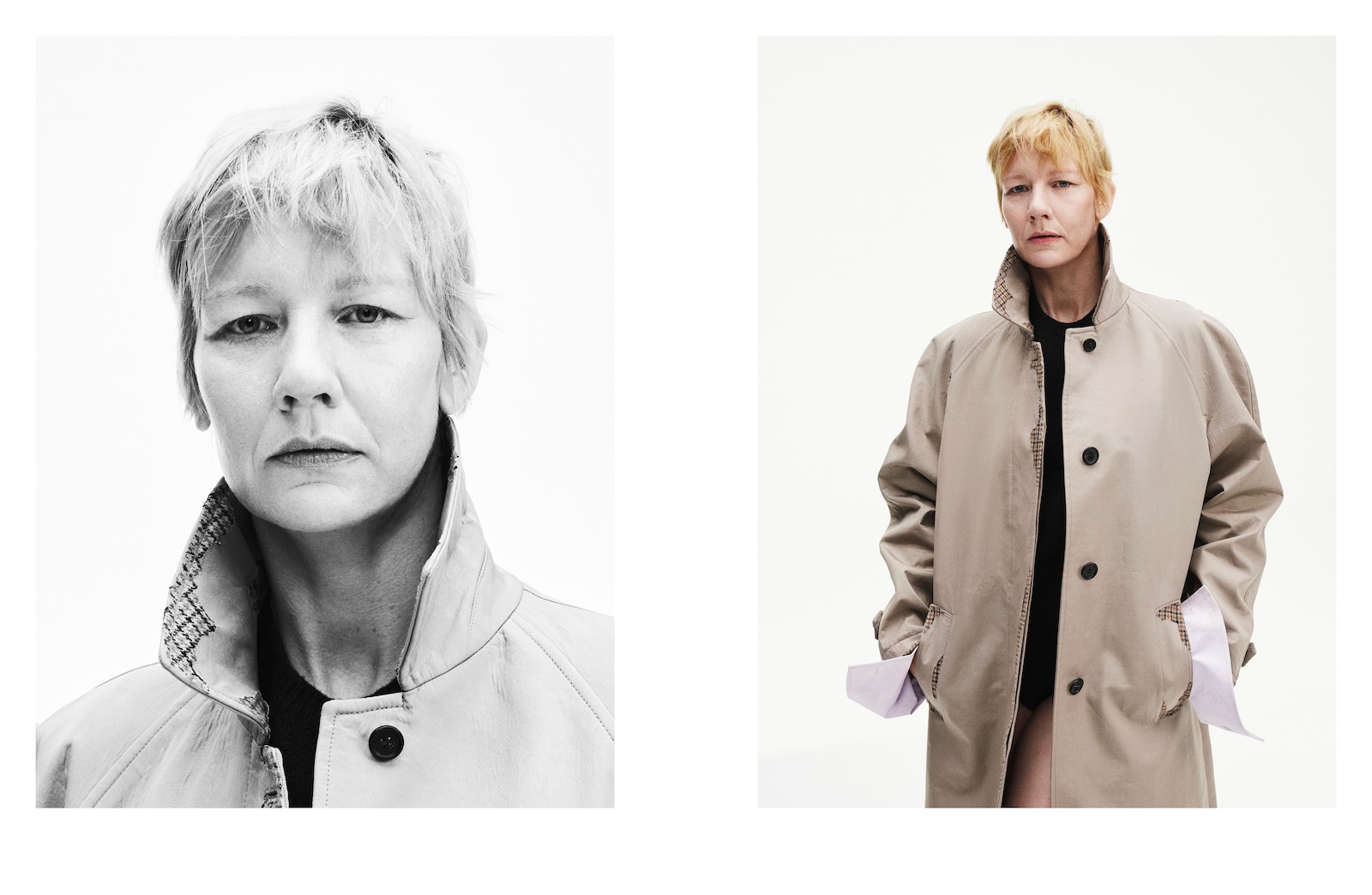
Hüller was 11 when the Berlin Wall fell in 1989, a destabilising moment for a watchful, serious-minded child – the outpouring of celebration was entwined with confusion for adults and children alike. “My whole childhood was East Germany,” she says. “I remember, especially the time before it happened, when people started to talk about it, but secretly, behind their hands. A girl came into school saying, ‘In two weeks this country is not going to exist any more,’ and it was unthinkable. It was a feeling like before an earthquake – the birds stop singing, the animals are quiet, you feel something is changing in the atmosphere. It was the feeling that something is coming that will have a huge impact on our lives.”
When a perceptive teacher suggested Hüller try acting, around the age of 15, that fine-tuned radar found an outlet. “I was in love with literature and language, with poetry – but then the question was, what are you going to do with this language?” she says. “I think my teacher thought the complex feelings I had as a child would be good to work with in theatre.” The first play she appeared in, Frank Wedekind’s Spring Awakening, was not high-school Bugsy Malone fare: an often-banned 1891 work about adolescent erotic desire in a stifling provincial town, it grapples with abortion, suicide and sexual abuse, threaded through with a grim vein of humour. German stagecraft, even for 15-year-olds, has long been an extreme sport. “I felt immediately that this was for me,” she says. “It kept my thoughts occupied for months. It was a bit like falling in love. You know this feeling that you have in your body, where you want to be in this place, with these people? It was obvious that I couldn’t let go of that.”
In 1996, after appearing in a play that travelled to Berlin, she began to think of studying in the capital. “Nobody told me how to access a drama school,” she says. “I had to go to what we call Arbeit – the job centre – and type into their computer, ‘how to become an actor’.” The famously rigorous Ernst Busch Academy was the first to offer her an audition. “After that I skipped all the others, because I knew I had found the place I wanted to go.” Only about 3 per cent of applicants make it through the academy’s auditions, which require Olympic levels of stamina. (Hüller did Thomas Brasch’s Lovely Rita, Lysistrata – and Romeo and Juliet.) She found a flat-share in a mostly pre-gentrified Prenzlauer Berg and became one of the academy’s youngest students, studying a curriculum that combines Brechtian double consciousness and Stanislavski psychological realism – the definitions of which we’ll leave for another day. It was the mid-1990s and Hüller was consuming Dogme 95 films by Thomas Vinterberg and Lars von Trier and spending her days steeped in training. “How to use your body to communicate. Learning whether your facial expressions are saying what you want to say or if you look different from how you imagine. How to use your voice without hurting it in a big room,” she remembers. “They wanted absolute commitment from students. I think that still helps me today to get through difficult situations on set or on stage.”

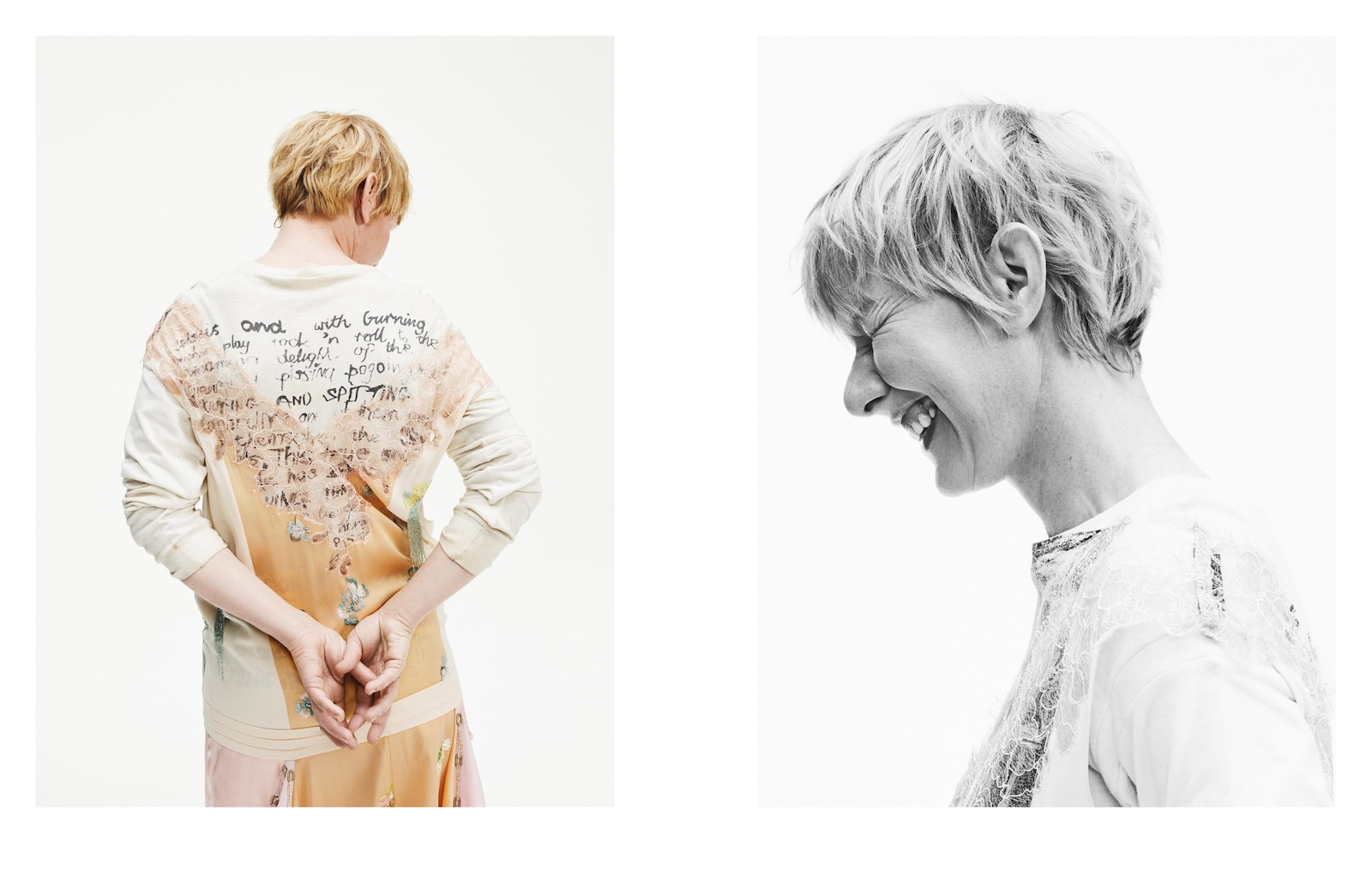
After graduating in 2003, Hüller plunged into the all-consuming world of theatre – in those days actors socialised, rehearsed and performed together round the clock, their kids in the dressing rooms. By the time she was living in Basel playing that pivotal Juliet, Hüller was often working seven days a week. When she auditioned for her first film – 2006’s Requiem – she could already electrify a room. She won the role after being asked, without warning, to dance for two minutes to a Deep Purple song, morphing from awkward to abandoned. “And there she stood after two minutes in this very austere casting studio, completely transformed, and dissolved into tears,” said the director Hans-Christian Schmid. The film is based on the distressing 1970s case of Anneliese Michel, a 21-year-old who suffered from epilepsy, interpreted by her devoutly Catholic family as demonic possession; Michel died after a series of exorcisms. Hüller brought a wrenching intensity to a young woman racked by familial and religious pressure, trapped amid the net curtains and crucifixes of a Bavarian backwater. During the shoot, Hüller shuttled back four hours or more in time for curtain-up in Basel; the self-possession she radiates today was evident then. “I think it’s about trusting your own strength and not thinking that someone else will take care of anything for you,” she explains in a behind-the-scenes documentary shot between takes. “I think that’s the most important thing in life and that doesn’t mean you can’t trust people. It simply means that ultimately you alone are responsible for everything you do.” Requiem won her the Silver Bear at the Berlinale in 2006, awarded by Charlotte Rampling, no stranger to uncompromising roles herself.
“The acting experience is not only in my head. It’s connected to my entire body” – Sandra Hüller
In the next few years, film and theatre alternated: onscreen, there was a deeply wounded mother on welfare, pinballing between childcare duties and grimy bars; a turn as the far-left militant Ulrike Meinhof; a filmmaker whose husband has a fetish for animal fur suits; a doctor with a compulsion for having sex with her patients. Then, in 2016, the bittersweet Toni Erdmann, in which Hüller plays the emotionally walled-off outsourcing consultant Ines, became the unlikely catalyst for her first trip to the United States, and Hollywood. Ines – all strict blouses, white-knuckle grip on her phone and cocaine as a workplace duty – is hijacked by a visit from her prankster father, who attempts to rekindle their relationship via an Andy Kaufman-like alter ego with oversized false teeth and an ill-fitting wig. During rehearsals, the director would test Hüller’s discipline by, for example, telling a supporting actor to wear a gigantic pair of ears. One indelible scene revealed her sublime gift for physical comedy: a battle with a too-tight dress parlayed into a mortifying naked team-building exercise and wayward act of feminist empowerment. The scene took three days to shoot and was a masterclass in committing hard to a scene. “I can only be funny out of desperation, when things go wrong,” she said of the deep sense of human despair that lurks beneath the film’s comedy. Hüller’s intangible combination of fierce control – every twitch and flinch precisely calibrated – and ability to shut her eyes and let go of the wheel is in full force towards the film’s climax, as she throws herself into a slightly off-key rendition of Whitney Houston’s Greatest Love of All to a roomful of nonplussed strangers at an Orthodox Easter gathering. It caused a spontaneous eruption of applause at the film’s Cannes premiere and the movie was nominated for an Oscar, a Bafta and a Golden Globe. There were rumours of a Lena Dunham-written US remake starring Kirsten Wiig and Jack Nicholson. But Hüller, always happier at the coalface than negotiating the praise that follows, was back in Germany the day after the Globes, being certified as a forklift-truck driver for a role as a supermarket employee working groundhog day shifts fuelled by vending machine coffee in Thomas Stuber’s In the Aisles. “That’s a real skill,” she said at the time. “I can always work in a warehouse, stacking crates. I’m completely serious. You never know where life will take you.”
It seems unfathomable that nothing concrete came of that first foray into US territory; instead, it was Europe that embraced Hüller. And her IMDb page, of course, is only half the story. The root of all that has come to fruition today was also forged on Ibsen and Aeschylus and Goethe, as well as some ferocious contemporary experiments: she has belted out Cyndi Lauper and Billie Eilish in a blonde wig and teetering heels for an adaptation of Luis Buñuel’s metaphor for a society in freefall, The Exterminating Angel, and tackled 26 PJ Harvey songs on a dirt-filled stage surrounded by thrashing dancers at the Ruhrtriennale arts festival. (We know from Project Hail Mary that Hüller’s voice sounds like “heavens pouring honey”, as Ryan Gosling put it. In 2020 she released her debut album, Be Your Own Prince – one of its music videos features an entirely deadpan Hüller negotiating how to lie horizontally across a chair.) Speaking of princes, her gender-fluid Hamlet, staged in Bochum, Germany, in 2019, was hailed as a vivisection of the nature of performance itself. “Hüller plays herself by being Hamlet,” wrote the jury of the Gertrud-Eysoldt-Ring, awarded annually for the most outstanding theatrical performance. During that production’s interval, she says she found herself unable to leave the stage, paralysed with her tragic character’s uncertainty. Audience members shuffled to and fro balancing drinks, but increasingly chose to remain with her for those 20 minutes under the comprehension that something rare and indefinable was taking place. “We would play volleyball before Hamlet,” Hüller remembers with a smile. “There was a lot of fun and screaming to get rid of the tension, to get into a similar playful state. And then, just before we entered the stage, we’d stand together behind the curtain and it was just the most beautiful moment ever.”

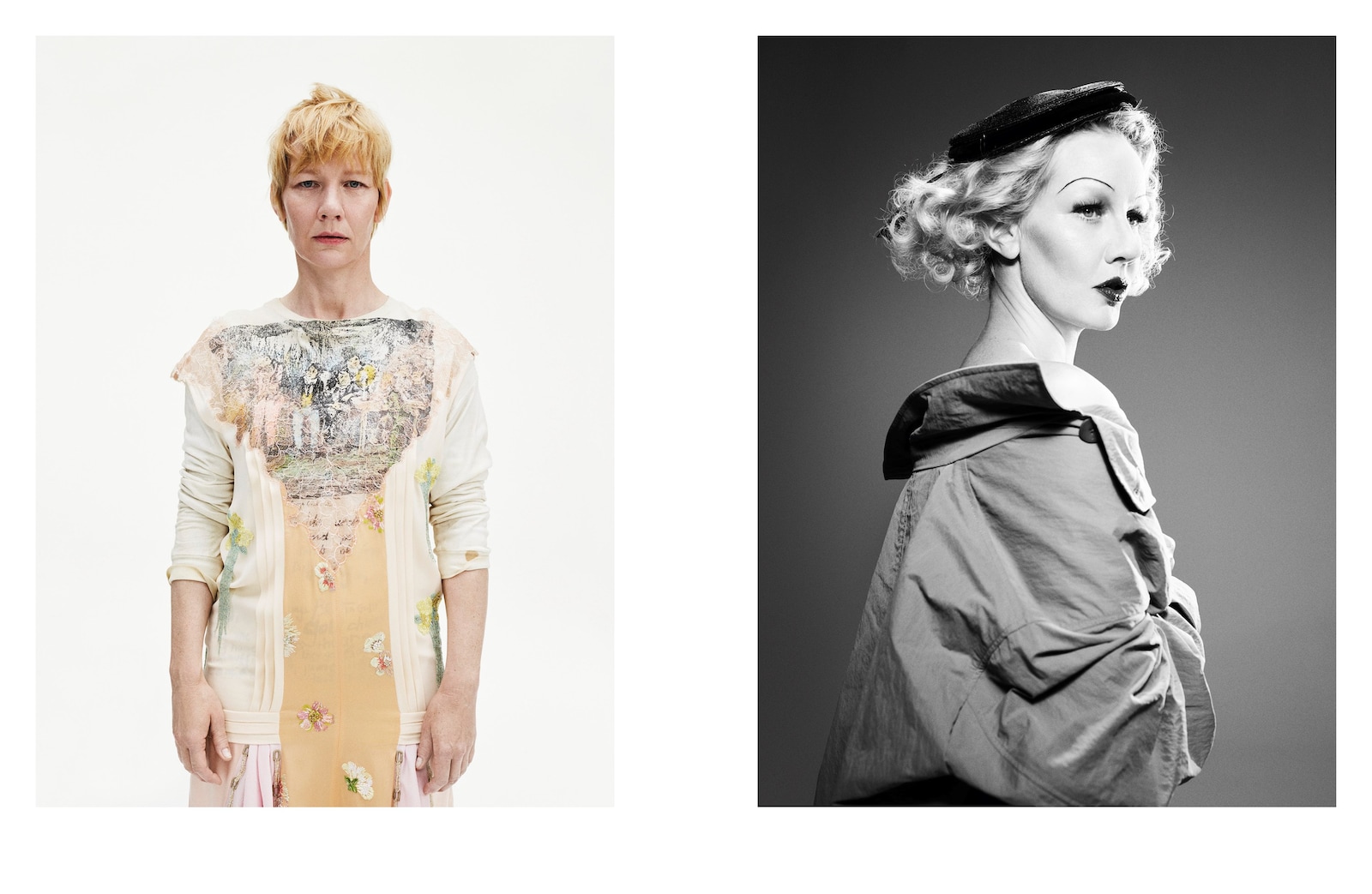
That play was helmed by Johan Simons, the pioneering theatre director with whom she has worked several times (and perhaps will do again – when we speak, she has just got off the phone with him). These days we’re used to seeing A-listers showing up in the West End or on Broadway to telegraph their seriousness, but Hüller was a theatre actor first and considers herself a theatre actor today. Two Cannes premieres in 2023, however – of Glazer’s jolting, queasy Holocaust drama The Zone of Interest and Triet’s knotty Anatomy of a Fall, which won the Grand Prix and Palme d’Or respectively – brought her the kind of worldwide attention that divides a career into before and after. Anatomy made Hüller the third German woman in Oscar history, after Luise Rainer and Marlene Dietrich, to be nominated in the best actress category. A merciless dissection of a modern relationship masquerading as a Hitchcockian Alpine whodunnit, Triet’s courtroom drama delves into muddy questions of power and interdependence, envy and blame, as prosecution and defence weave their competing tales about the guilt or innocence of Hüller’s character (also called Sandra, not coincidentally – Triet wrote it for her). Sandra’s knife twist of a “You are not a victim” speech, in which she dismantles her husband’s self-pity in flashback, became a Rorschach test for the ways we perceive powerful women, a lightning rod for discourse around the double bind that mothers face – and an avalanche of memes, TikToks and lip-syncing videos. Hüller had hit a nerve. “I know a few women who live in the sort of relationship where they protect their husbands from the truth because it’s too hard,” she said after the film’s release. “I was a big fan of the idea that someone has the balls to say it.”
Just three days before the premiere of that high-wire performance, though, Hüller had been virtually unrecognisable, her face drained of all charisma, in the Cannes screening of The Zone of Interest. As Hedwig Höss, wife of the Auschwitz commandant Rudolf Höss, she strides grumpily around her mansion, tending to her dahlias in dull housedresses and taking her pick of lipsticks stolen from victims of the death camp that looms on the other side of her barbed-wired garden walls. She is both grotesque in her narcissism and utterly banal. Hüller’s roles so often stem from a feeling that we are hardwired for empathy – but she approached Hedwig in an entirely different way, all but extinguishing her character’s inner life. “You have to make a decision if you’re going to stick to the things that work for you or learn something new, work without the tools you normally use,” she says of playing her. “Jonathan [Glazer] and I agreed very early on that this person was not going to get any of my empathy, my love, my capability for feeling things. I decided I would put a costume on and say the lines I have to say but I would not sympathise with her or defend her.” Instead she approached Höss physically: how would she bake a cake or peel a potato? “She was brought up as a farmer, she had five children, probably without any physicians around her – I thought about her physicality, her spine,” Hüller says. “But I also thought that was a form of punishment or revenge – I didn’t give her the possibility to be the woman she wants to be. She wanted to be a lady, a rich elegant woman, but she will never fit in those clothes, she will never feel like the person she wants to be.”
Glazer’s shoot was as close to theatre as film gets: he hid cameras in bookshelves and bushes and picnic paraphernalia, operating them remotely to capture his cast surveillance-style as they went about their quotidian activities, set against a nightmarish soundscape of cries, gunshots and ambient industrial noise. Its primordial horror left viewers, cast and crew stricken. But when shooting wraps, Hüller says she has no system for dispensing with her characters; there seems to be a firm sense of self to return to. “I just have to take off the coat and go. But,” she says, “I don’t like to go from project to project. I find that very distracting. It sucks the light of life out of me. It’s draining. I have to be home for quite some time until I can do something else.”

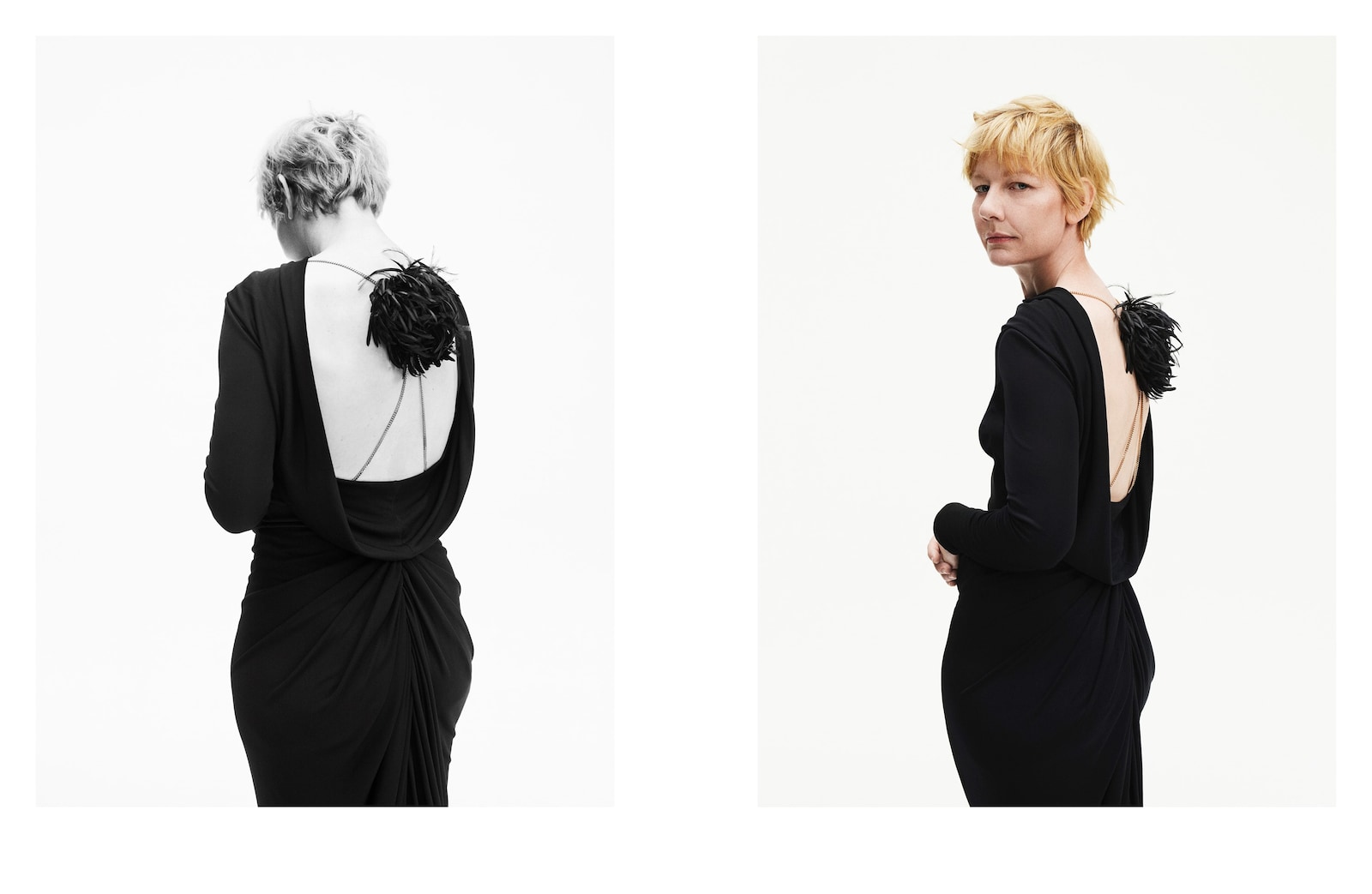
That is proving harder since Hollywood came calling, decisively this time, and since Gosling overheard her singing in her dressing room on the set of this year’s Project Hail Mary, a sci-fi with the old-school charm of early Spielberg. He suggested her dauntless mission leader Eva Stratt – “I kind of liked the idea of playing someone who I would actually want to be governed by,” Hüller says – sing karaoke, and with a heart-clenching cover of Harry Styles’s Sign of the Times, Hüller inadvertently went viral again, giving the film its unofficial anthem. The moment had a pleasing circularity with her barnstorming Whitney Houston rendition in Toni Erdmann, though Hüller is not keen to overplay its significance. “We did it without any rehearsal. I thought it was just a small scene that we added. It was fun to make, fun to sing to Ryan and the others,” she says. “Overnight I Googled ‘goodbye songs’, and when I read the lyrics, I thought, this is probably the right thing. Then I called my daughter the next day to check that it was a good song and she said, yes, of course. And that was it.”
“Almost everybody remains with you ... I think of them all once in a while” – Sandra Hüller
If Hüller has felt fazed by the increasing scale of her filmography, it’s not evident – chalk it up to Ernst Busch training or facing down the hot breath of a live audience or just being constitutionally not inclined. Her next co-star is Tom Cruise, no less, in the guise of a delusional oil tycoon in Digger, Alejandro González Iñárritu’s $125 million black comedy of climate apocalypse that, from its trailer at least, looks like a hyper-charged Dr Strangelove with the addition of a one-eyed cat. NDAs prevent Hüller from revealing anything apart from her appreciation for cast and crew: “Tom Cruise was obviously an idol – I loved Days of Thunder and Rain Man. With Iñárritu, he was somebody I thought I would like to spend time with no matter what came up. Digger was so interesting to explore because it’s a tone I haven’t used many times – maybe in theatre, but not on film. This form of telling a story is also something Iñárritu didn’t have so much experience with, and that’s what he told me from the beginning – ‘We will find out together how it works.’ And that’s what we did.”
Digger is, like Fatherland, Oscar tipped. Meanwhile, at the Berlinale this year, Hüller won another Silver Bear, exactly 20 years after her first, for Schleinzer’s macabre gothic folktale Rose, set in God-fearing Germany after the Thirty Years’ War. She learnt to load and fire an antique musket and drive a cattle wagon for her role as a woman passing as a man – breasts bound, animal’s horn in her trousers, the left side of her face scarred and disfigured by a bullet. “The script was like a beautiful long poem,” she says. “I wanted to get inside that language.” Captured in velvety black and white, Rose draws on Hüller’s inscrutability (her friend Triet calls her “ungraspable”), which onscreen has a way of forcing us to confront our own internal contradictions, biases and unexamined urges. An excoriating interrogation of the ways that religion can be wielded to uphold violent, patriarchal power, Schleinzer’s film feels troublingly timely despite its 400-year-old setting; Hüller’s character pays a devastating price for her transgressions, though the violence mostly stays offscreen. “I have so many discussions, onstage too, about showing violence,” she says. “Do I really need to see another person be beaten to death or another woman raped? No, I don’t. So I’m a big fan of showing the consequence of violence but not the violence itself.”

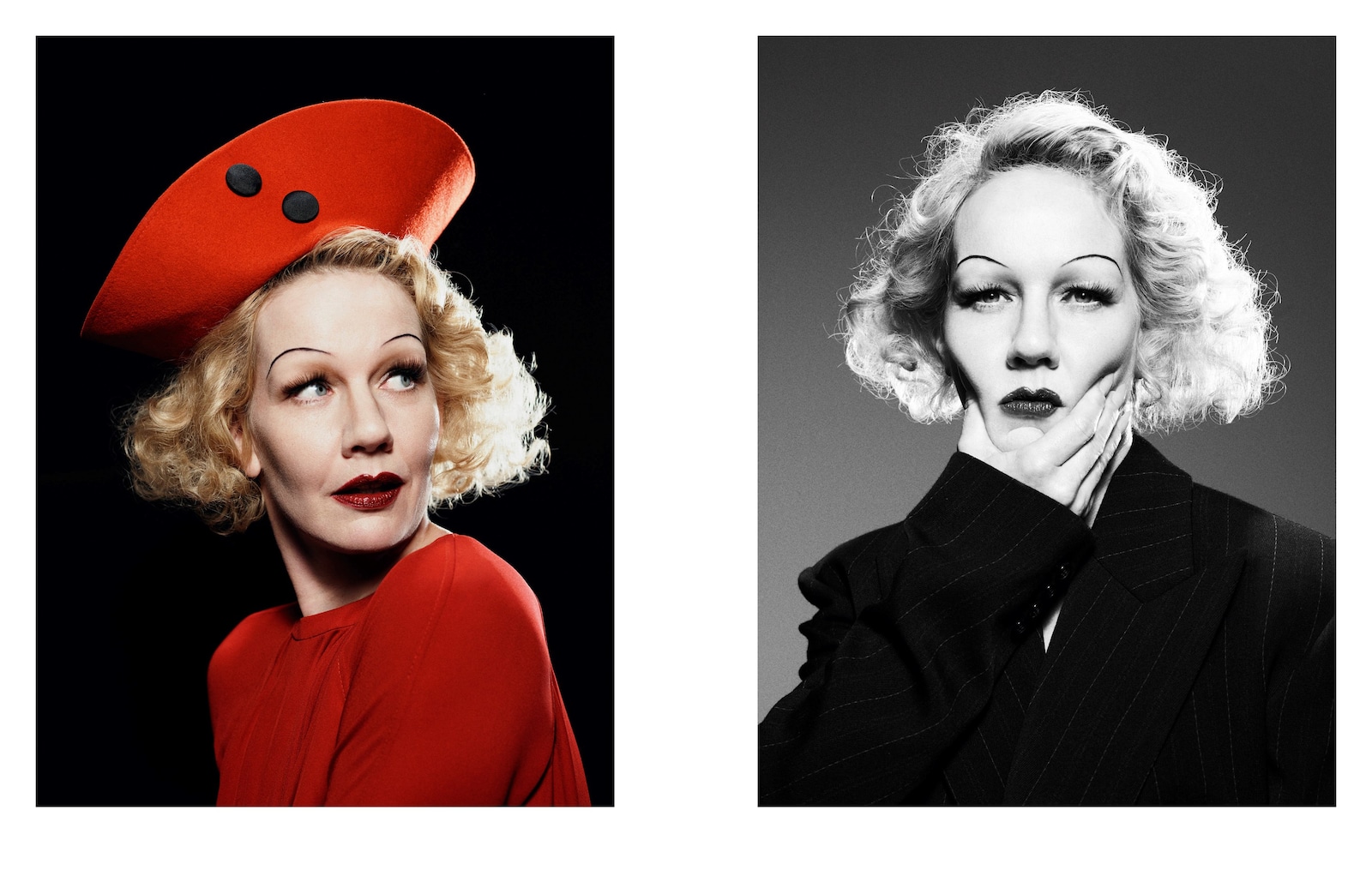
The choice of that artful monochrome gem, unshowy and unyielding, on the heels of the $248 million Project Hail Mary felt like a statement of intent for the ways Hüller plans to negotiate the demands of those directors now competing for her time. The rich spectrum of stories she gives voice to continues to widen, expanding the possibilities of the screen in parallel. “Almost everybody remains with you,” she says of the characters she has communed with in all their melancholy and stillness, rage and grief, on sets and stages large and small. “I think of them all once in a while. Things will suddenly remind me of them. Because if they let you, it becomes a very strong connection. They’re people you once knew – old friends.” A case in point: after we finish speaking, Hüller plans to go horse-riding, a skill she had to master while shooting her role in Sisi & I, a raucous, revisionist look at Empress Elisabeth of Austria and her obsessive companion. “I learnt how to ride and after we finished the film I felt, well, why should I stop now?” she says with a shrug. “It feels weird to learn a thing for a movie and then just kick it out again.” Meanwhile, in her closet hang Erika Mann’s impeccably tailored wide-legged trouser suits – “They were made for me, so it would be a pity not to wear them,” she says. In general, though, Hüller doesn’t keep mementoes from her films – they tend to feel discordant back home in Leipzig. Shards of her characters remain with her not in physical form so much as in her bone marrow. “I mean, for me, the acting experience is not only in my head. It’s connected to my entire body, and when you have a physical experience with something, it sticks. It’s the same with traumatic experiences or when you fall in love with someone,” she says. “It lingers in your body for a long time. If not for life.”

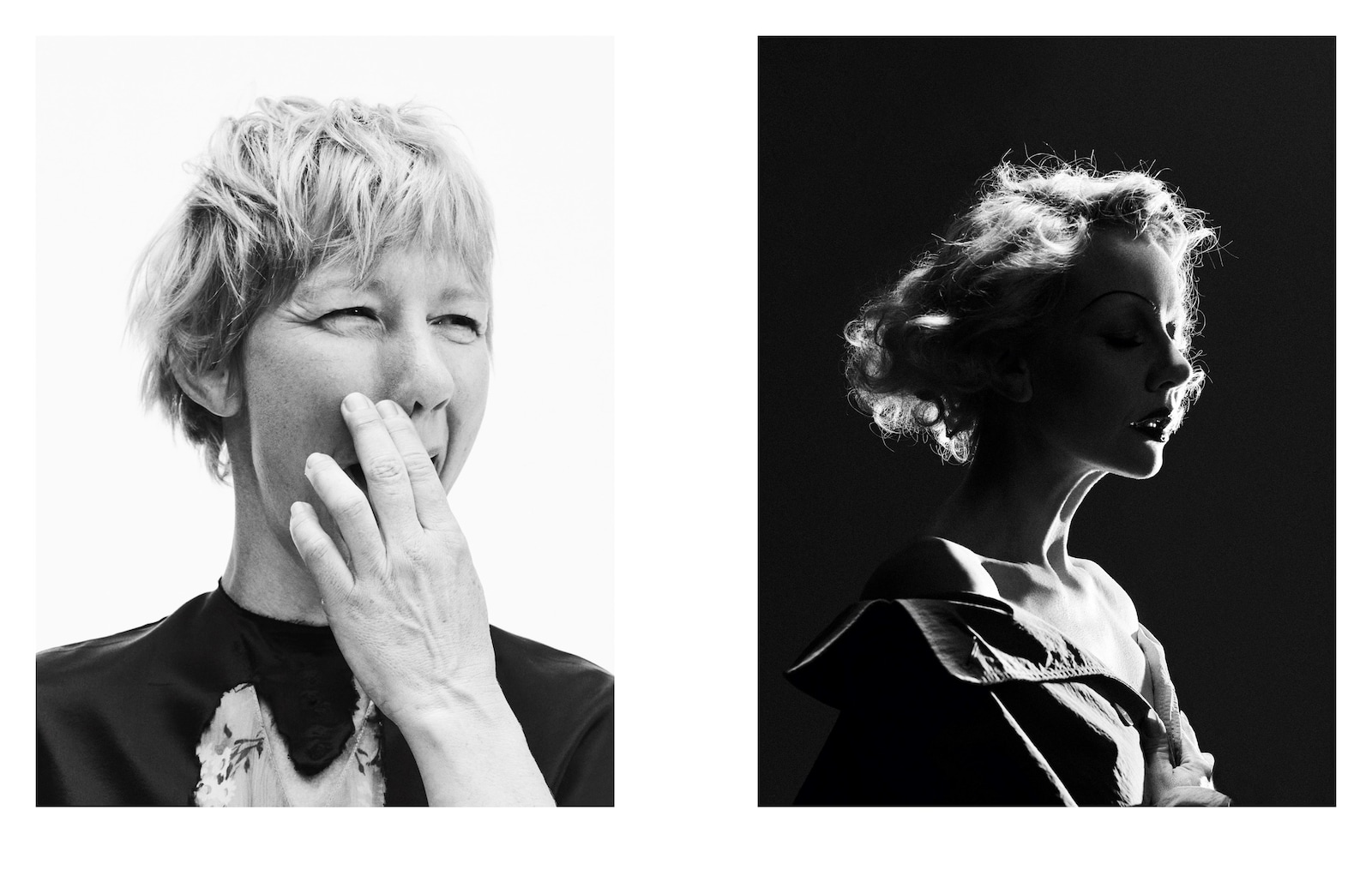
Hair: Cyndia Harvey at Art Partner. Make-up: Lynsey Alexander at Jolly Collective using MAC and ESTÉE LAUDER. Manicure: Rebecca Jade Wilson at The Wall Group. Lighting director: Romain Dubus. Digital technician: Henri Coutant. Photographic assistants: Tomo Inenaga and David Vail. Styling assistants: Francisco Reis, Izzi Lewin and Alexander Bainbridge. Seamstress: Gillian Ford. Hair assistant: Karen Bradshaw. Make-up assistant: Fernanda Paz. Studio manager to Willy Vanderperre: Charlotte Cogen. Production: 138 Productions. Executive producer: Simon Malivindi. Producer: Holly Gore. Production managers: Rosie Cartwright and Barbara Eyt. Production assistants: Adam Wells and Angela Ogunfojuri. Post-production: Stéphane Virlogeux
This story features in the Autumn/Winter 2026 issue, marking 25 years of AnOther Magazine, on sale internationally from 17 September 2026. Pre-order here and here. Paweł Pawlikowski’s Fatherland is out in cinemas 23 October and Markus Schleinzer’s Rose is out in cinemas 5 February, 2027.